
 By
·
5 minute read
By
·
5 minute read
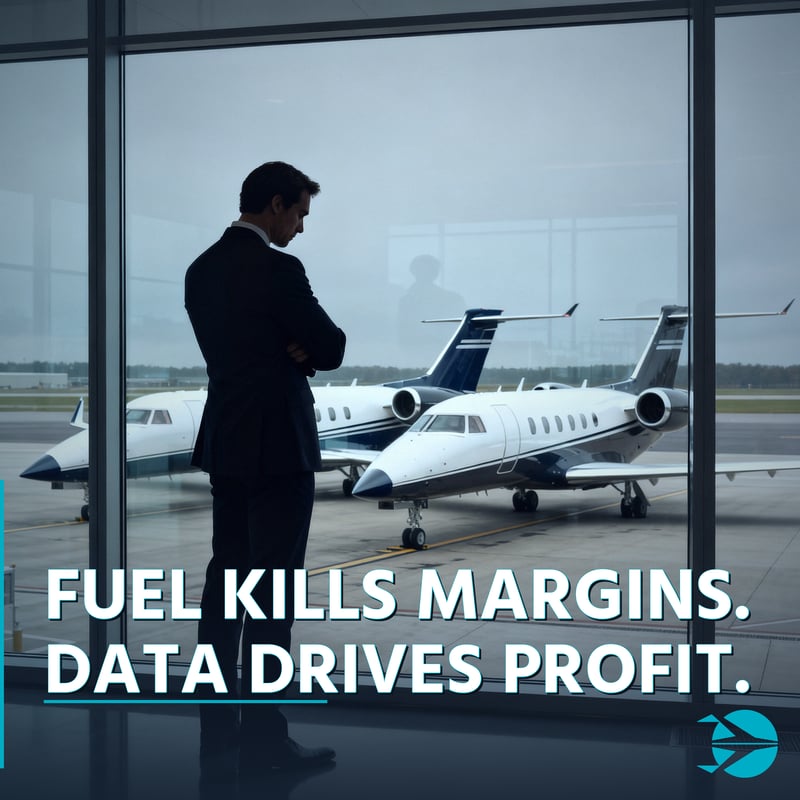
When jet fuel crosses $200 per barrel, airline economics break down fast — especially on short-haul routes where thin load factors and high per-seat fuel burn make profitability nearly impossible. United, American, and regional carriers have already begun pulling back from routes under 500 miles. That's not speculation. That's the filing data.
For Part 135 operators, this creates something rare: a demand wave you didn't have to manufacture. Passengers who once flew commercial between secondary markets — think Raleigh to Savannah, Bozeman to Salt Lake City, Tulsa to Dallas — are suddenly without viable options. They're not abandoning the trip. They're looking for another way to make it.
The question isn't whether this demand exists. It does. The question is whether you can price it correctly, fast enough, to actually make money on it.
The Opportunity Is Real — and Already Shrinking
Airlines don't announce route cuts all at once. They reduce frequency first. Then they consolidate to hubs. Then they drop the route entirely. That process is already underway: according to data from OAG, regional airline seat capacity on sub-500-mile routes has contracted by more than 12% in the past 18 months, with the pace accelerating as fuel costs climb.
That contraction doesn't kill the demand. It displaces it.
The travelers who relied on those connections are business passengers with fixed schedules, executives who can't add a three-hour drive to a day trip, and medical travelers who have no flexible alternative. These aren't leisure flyers who'll just wait for a better fare. They're time-sensitive, budget-justified buyers — the exact profile that converts to charter at high rates when given a real quote, fast.
One Midwest-based Part 135 operator saw inbound charter inquiries from first-time commercial flyers increase by 31% in a six-month period that directly overlapped with a regional carrier pulling service from two secondary airports in their market. They were positioned to respond. Most operators in similar situations weren't — because they were still pricing off a spreadsheet and routing the request through an ops coordinator.
The window here is real. It's also time-limited. As fuel costs stabilize or carriers adjust their networks, the displacement effect narrows. Operators who build the infrastructure to capture this demand now will lock in relationships — and repeat business — that outlast the disruption.
Static Pricing Will Eat Your Margin Before the Trip Pays Off
Here's where the opportunity turns into a trap for underprepared operators.
Stranded commercial passengers are a new buyer type. They're not charter-native. They don't have a broker relationship. They're searching, comparing, and making decisions quickly — often within hours of their original flight being cancelled or rerouted. That urgency is your advantage. But it only pays off if your quote reflects current trip economics, not last month's fuel average.
At $200/barrel Jet-A, the fuel cost difference between a quote built on 30-day-old pricing data and one built on today's market price can run $800 to $1,400 on a two-hour regional leg, depending on your aircraft. On a $6,500 trip, that's not a rounding error. That's 15–20% of your gross revenue disappearing before the wheels leave the ground.
Max has watched this pattern play out across dozens of operators: "The numbers don't lie. Operators who respond in under five minutes convert at three times the rate of operators who respond in an hour. But if they're quoting fast with stale pricing, they're winning business they're losing money on. Speed without accuracy is just a faster way to erode margin."
Real-time fuel cost integration isn't a feature — it's the difference between capturing this demand wave profitably and using it to fund your competitors' next acquisition. Sentinel pulls live Jet-A pricing into every quote, so what goes out the door reflects what you're actually paying at that departure airport, today. Not Tuesday's average. Not the FBO's posted rate from last week.
Response Speed Is the Variable That Separates Winners From Spectators
Short-haul displacement demand has a specific behavioral pattern: it peaks in a narrow window. A passenger who just found out their 11:15 AM regional flight was cancelled has a two-to-four hour decision window before they either reschedule, drive, or commit to the charter option that responded first.
Sarah is direct about what this means operationally: "Your competitor already sent that quote. First in wins. Every minute you wait, someone else is closing — and in this market, that someone else might be an operator who added Sentinel last month."
The data backs this up. Across charter bookings analyzed in 2023 and 2024, operators who responded to a new inquiry within five minutes were 3x more likely to win that trip than operators who responded within the hour. That gap doesn't shrink during high-demand surges. It widens — because more operators are competing for the same pool of newly available buyers.
Manual quoting processes — the kind that require someone to pull up fuel costs, check aircraft availability, calculate positioning, apply margin, format a PDF, and send it — take anywhere from 25 minutes to two hours depending on how the workflow is structured. That's the response window your competitor is operating inside while you're still building the quote.
Sentinel generates a complete, margin-safe quote in under 60 seconds. The math uses live inputs: current fuel, current positioning costs, real-time demand signals that tell you when and where charter interest is spiking. When a regional airline drops a route and 40 passengers start searching for alternatives, Sentinel operators are already responding to the first few inquiries before the majority of competitors have opened their inbox.
How to Position Your Fleet for Regional Surge Demand Without Overcommitting
Capturing displacement demand doesn't mean accepting every trip at any margin. It means knowing which trips, at which prices, on which routes, are worth pursuing — and having the intelligence to make that call in real time rather than on instinct.
Here's what the data says about regional trip economics at current fuel levels: the optimal margin window for sub-500-mile charters sits between 22% and 31% net, depending on aircraft type, when live fuel costs are factored into the quote. Operators pricing below that range are subsidizing the trip. Operators pricing above it are losing bids to more aggressively positioned competitors.
The operators capturing the most revenue from the current short-haul disruption aren't necessarily those with the most aircraft or the best routes. They're the ones with the clearest picture of their actual operating costs per nautical mile, per aircraft, per day — and the ability to apply that picture to an inbound inquiry in real time. "One operator did this and grew 417%," Max notes. "Not because the market handed them trips. Because they could see the market clearly enough to move before anyone else."
Sentinel's demand signal layer shows operators where charter interest is clustering — by market, by aircraft category, by time window. When commercial service pulls out of a city pair, that signal spikes. Operators using Sentinel don't wait for the RFQ to arrive. They're already positioned: rate cards loaded, availability confirmed, quoting infrastructure ready. The trip comes in, the quote goes out in under a minute, and the booking lands before the passenger ever picks up the phone to call a broker.
That's not a passive strategy. That's what it looks like to hunt trips instead of wait for them.
The short-haul retreat is real, the demand is there, and the margin is available — but only to operators who can move at the speed the market requires. Static spreadsheets, manual workflows, and gut-feel pricing are tools built for a market that no longer exists. The operators building revenue in this environment are running on live data, live costs, and AI-driven quoting that closes the gap between inquiry and booking to under 60 seconds.
If your operation is positioned to compete for this demand, the next step is seeing exactly how Sentinel works inside a real operator workflow. Book a 15-minute demo at sentinelcharter.com — no slides, no pitch deck, just a live look at what your quoting process looks like when it runs at computer speed.
[Request our operator case study — see the 417% revenue growth breakdown](#)