
 By
·
4 minute read
By
·
4 minute read
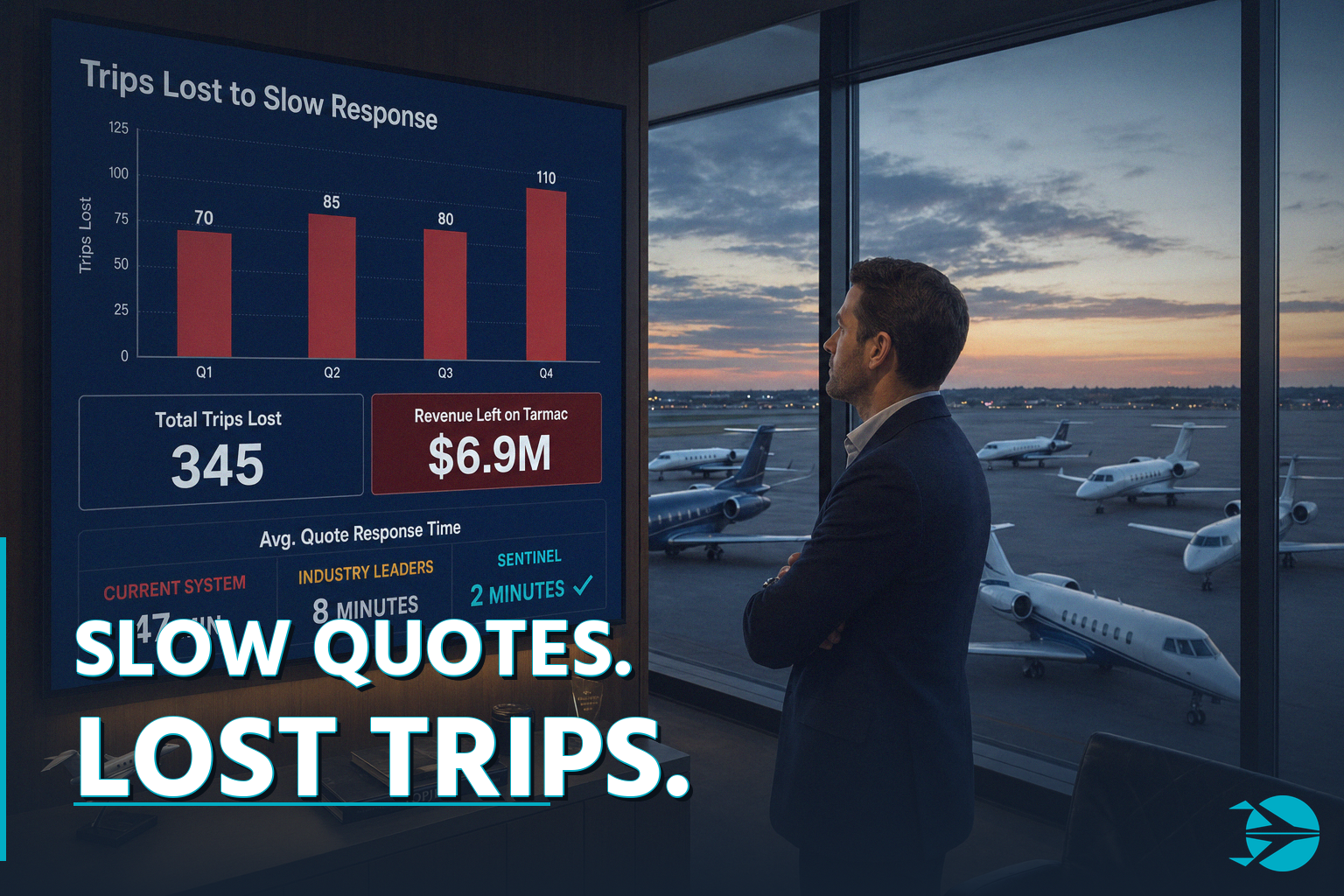
Talk to enough Part 135 operators and you hear the same frustration: the software built to run their business has become its own obstacle. Across charter sales, MRO, and flight training, operators report spending more time navigating their platforms than actually running their operations. For MRO shops and compliance teams, that friction is an inconvenience. For charter sales, it's a revenue leak.
The distinction matters. When a broker sends an RFQ at 11:07 a.m. and expects a quote back by 11:27 a.m., your software isn't a back-office tool anymore. It's your fastest salesperson — or your slowest bottleneck. Most legacy platforms are the latter, and they were built that way on purpose. Not because the vendors were careless. Because they were building for everyone, which means they were optimized for no one.
The Platform Was Built for MRO. Your Sales Floor Inherited It.
Here's a pattern that plays out across charter operations nationwide: a flight department running Corridor or Leon — or any of the multi-module legacy suites — originally licensed the platform to manage scheduling, maintenance tracking, and regulatory compliance. The charter sales module came later, either bundled in at renewal or bolted on as an upsell.
That origin story has consequences.
The quoting workflow in most legacy platforms reflects the architecture of the system it was added to, not the workflow of a charter salesperson under time pressure. NBAA's operational tools guidance has long emphasized that workflow design should match the operational context of the user. Charter sales is a distinct context — it runs on urgency, margin awareness, and competitive timing. A system designed to track a 90-day MRO project does not share those priorities.
The result, operationally: operators clicking through 14 screens to generate a quote that a competitor with a purpose-built tool sends in under four minutes. That's not a training problem. It's a design problem. You can't train someone out of a bad workflow. You can only hire more people to absorb the friction — or switch to infrastructure that was designed for your actual job.
A 20-Minute RFQ Window Doesn't Care About Your Software's Feature Count
The data on response speed in charter sales is not subtle. IBISWorld's charter transportation industry data and operator-level performance tracking consistently show that operators who respond to RFQs within the first five minutes are significantly more likely to win the trip than those who respond at the 15- to 20-minute mark — even when their pricing is identical.
Brokers have a queue. The first credible quote that hits their inbox anchors the deal. Everything after that is comparison shopping.
Sarah, Sentinel's VP of Aviation Sales, puts it plainly: "Your competitor already sent that quote. The call went to someone else. That's not a market problem. That's a software problem."
A 20-minute RFQ window doesn't care that your platform has 47 features. It cares whether you can pull live fuel costs, run a margin check, attach your compliance packet, and send a professional quote before the broker moves on. Legacy platforms make that sequence a multi-tab, multi-click ordeal. Sentinel runs it as a single workflow — quote, compliance packet, margin check, send — because that's the only workflow it was built to execute.
Sixty percent fewer clicks to quote than legacy platforms. That's not a marketing claim. That's a workflow audit. Count the screens yourself.
Feature Bloat Has a Measurable Cost — Operators Are Starting to Calculate It
Max, Sentinel's Charter Operations Executive, has a consistent observation about operators who come off legacy platforms: "The numbers don't lie. When we map their historical response times against their win rates, the correlation is immediate. Slow software shows up in lost revenue before operators realize the two are connected."
Here's the math that most operators haven't run:
If your operation handles 40 RFQs per month and your average response time is 18 minutes, you're likely losing 30–40% of those trips to faster competitors — before price ever enters the conversation. At an average charter revenue of $18,000 per trip, that's between $216,000 and $288,000 annually in opportunities that left your pipeline because your quoting tool couldn't keep pace. ARGUS International's charter market intelligence has tracked response-time-to-win correlations in the on-demand segment, and the pattern holds across aircraft categories and market conditions.
The feature bloat compounding this isn't neutral. Every unnecessary screen, every redundant data entry field, every modal that interrupts a quote to prompt a maintenance record update — that's time added to your response cycle. Legacy platforms often require operators to navigate through compliance and scheduling modules just to reach the quote function. The features aren't wrong, exactly. They're just in the wrong order for a salesperson racing a 20-minute clock.
One operator who moved to Sentinel's single-workflow quoting saw a 417% revenue growth within 18 months of implementation. The mechanics behind that growth aren't complicated — faster quotes, more quotes sent, higher win rate, compound revenue growth. The platform didn't create new demand. It stopped blocking the operator from capturing demand that was already there.
Request our operator case study — see the 417% revenue growth breakdown.
Speed-to-Quote Is Infrastructure, Not Strategy
There's a framing problem in how operators think about their software stack. Most treat quoting tools as administrative infrastructure — something to evaluate at renewal, optimize with training cycles, and tolerate between contract periods. The 2026 feature bloat analysis exposed why that framing is expensive: when your quoting tool is slow, you're not experiencing an administrative inconvenience. You're losing trips in real time.
Harvard Business Review's widely cited research on sales response speed established that the odds of qualifying a lead drop dramatically after the first five minutes of inquiry — a pattern that translates directly to charter RFQ dynamics. Brokers move fast because their clients are moving fast. A first-class passenger on American or Delta who decides to upgrade their return leg to charter isn't waiting 25 minutes for a quote. Neither is the corporate travel manager booking a last-minute board trip.
The operators who are winning in the current market have made a structural decision: they've stopped treating speed-to-quote as a training goal and started treating it as a platform requirement. That's the shift. Not a new sales process, not a larger team, not a revised comp structure. Infrastructure that operates at the pace of the market, not at the pace of a legacy software suite designed for six different user types.
Sentinel was built from the first line of code around one workflow. Not MRO. Not scheduling. Not compliance reporting, though compliance travels with every quote automatically. Charter sales. Quote, compliance packet, margin check, send. That's the entire design brief. No workarounds. No inherited complexity from a module built for a different operation. Sixty percent fewer clicks isn't an efficiency gain — it's the result of removing everything that was never supposed to be there in the first place.
The market in 2026 is running on broker platforms, aggregated RFQ feeds, and demand signals that didn't exist five years ago. The operators calibrating their infrastructure to match that pace are pulling ahead. The operators running 14-screen quote workflows are losing trips to competitors they never see coming.
If you're running a Part 135 operation and your quoting tool requires a training cycle to use correctly, that's the signal. The tool should be faster than your most experienced salesperson, not slower. Book a 15-minute demo at sentinelda.com and we'll show you the workflow comparison side by side — your current screen count against ours. Bring a stopwatch.